🗂️ Database Architecture Overview
Overview
This section documents the complete database architecture of the CivicEdge platform.
The database is designed using a bounded-context–oriented approach, where each domain owns its data while sharing a common relational database.
Instead of a single monolithic schema, CivicEdge organizes data around clear functional responsibilities, improving maintainability, scalability, and clarity.
🧠 Design Philosophy
The database architecture follows these core principles:
- Bounded Contexts for domain separation
- Single Source of Truth per responsibility
- Clear ownership of tables
- Minimal cross-context coupling
- Audit-first modeling
- Future-safe extensibility
All tables belong to exactly one context, even though they share the same physical database.
🗺️ Full Database Diagram
The diagram below represents the complete logical database structure of CivicEdge, showing how contexts interact through controlled relationships.
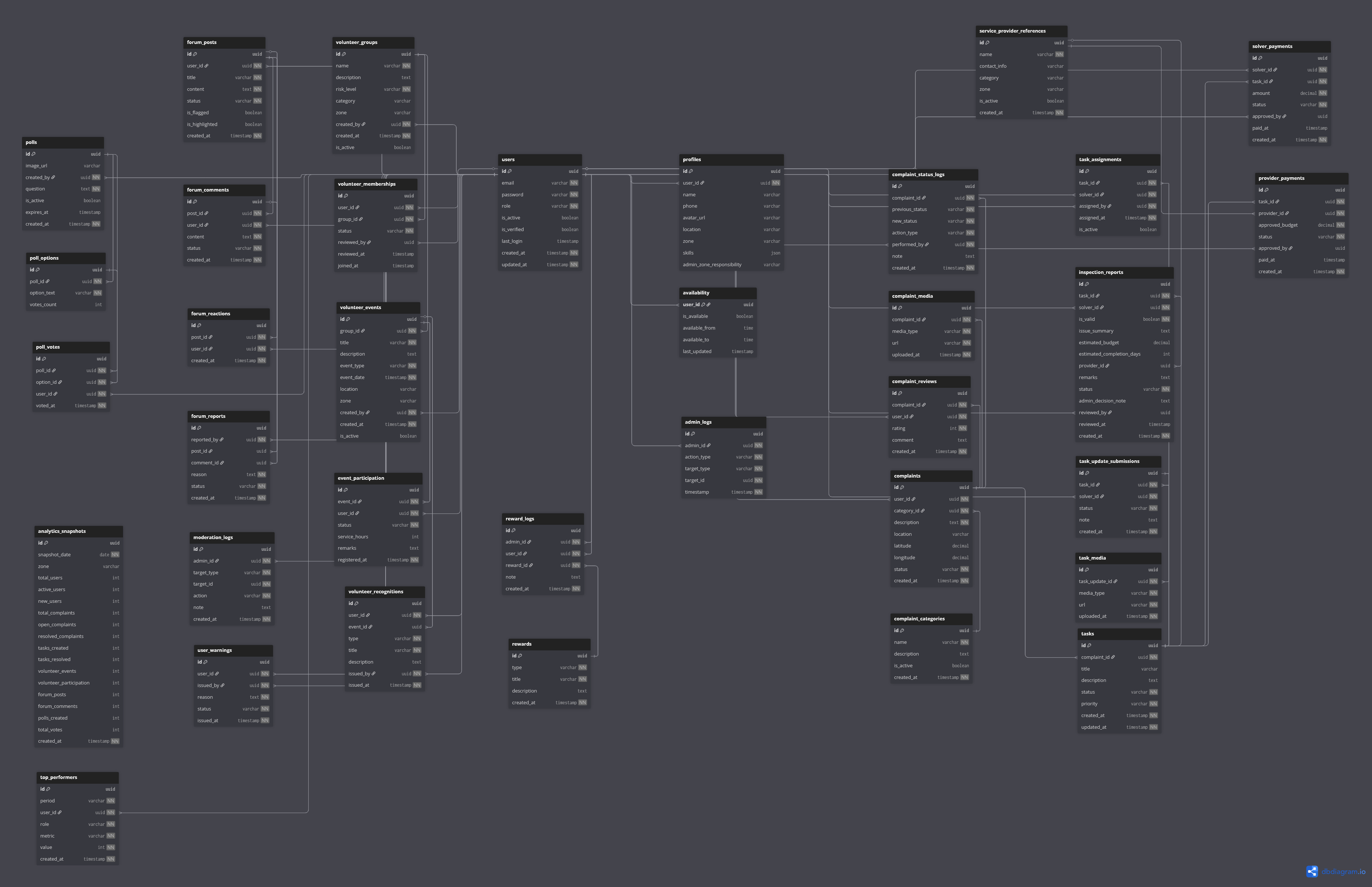
🧩 Database Context Map
The CivicEdge database is divided into the following bounded contexts:
| Context | Description |
|---|---|
| User Context | Identity, roles, profiles, availability, and audit logs |
| Complaint Context | Citizen-reported civic issues and lifecycle tracking |
| Task Resolution Context | Field execution, inspections, and progress updates |
| Provider Context | External service provider references |
| Volunteer Context | Community armies, events, and participation |
| Forum Context | Community discussions and moderation |
| Polling Context | Civic opinion collection and voting |
| Rewards Context | Recognition and appreciation |
| Payments Context | Financial reference tracking |
| Analytics Context | Aggregated insights and system metrics |
Each context is documented independently within this section.
🔗 Cross-Context Relationships
While contexts are logically isolated, controlled relationships exist:
- Complaints → Tasks
- Tasks → Payments
- Tasks → Providers
- Users → All contexts
- Analytics ← All contexts (read-only)
No context is allowed to directly modify data owned by another context.
🧭 Navigation Guide
To explore the database documentation:
- Start with this overview
- Choose a context based on functionality
- Review the context overview
- Drill down into individual table documentation
This layered approach ensures clarity even as the system grows.
🔑 Summary
The CivicEdge database architecture balances real-world civic workflows with clean domain boundaries.
By combining relational consistency with bounded-context thinking, the design remains:
- understandable
- scalable
- auditable
- and future-ready
This structure enables CivicEdge to evolve without requiring disruptive schema redesigns.