🛠️ Task Resolution Context
Overview
The Task Resolution Context is responsible for transforming verified complaints into actionable field work and tracking their execution until completion.
This context represents the operational layer of CivicEdge — where civic issues move from reports to real-world resolution.
In simple terms, this context answers:
How is the reported problem resolved?
🎯 Responsibilities
The Task Resolution Context handles:
- Creation of tasks from verified complaints
- Assignment of solvers by administrators
- On-site inspection and validation
- Budget estimation and resolution planning
- Progress updates and field submissions
- Media-based proof of work
- Task lifecycle tracking
This context focuses on execution, not reporting.
🧩 Owned Models
| Table | Description |
|---|---|
tasks |
Work units created from verified complaints |
task_assignments |
Tracks solver assignment history |
inspection_reports |
On-site verification and resolution planning |
task_update_submissions |
Progress and completion updates by solvers |
task_media |
Visual proof uploaded during task updates |
🔗 Relationship Overview
- A task is created from one complaint
- A task may have multiple solver assignments (history-based)
- Only one solver is active at a time
- A solver submits inspection reports
- A task may receive multiple progress updates
- Each update may include multiple media files
The task becomes the execution authority after complaint approval.
🖼️ Context Diagram
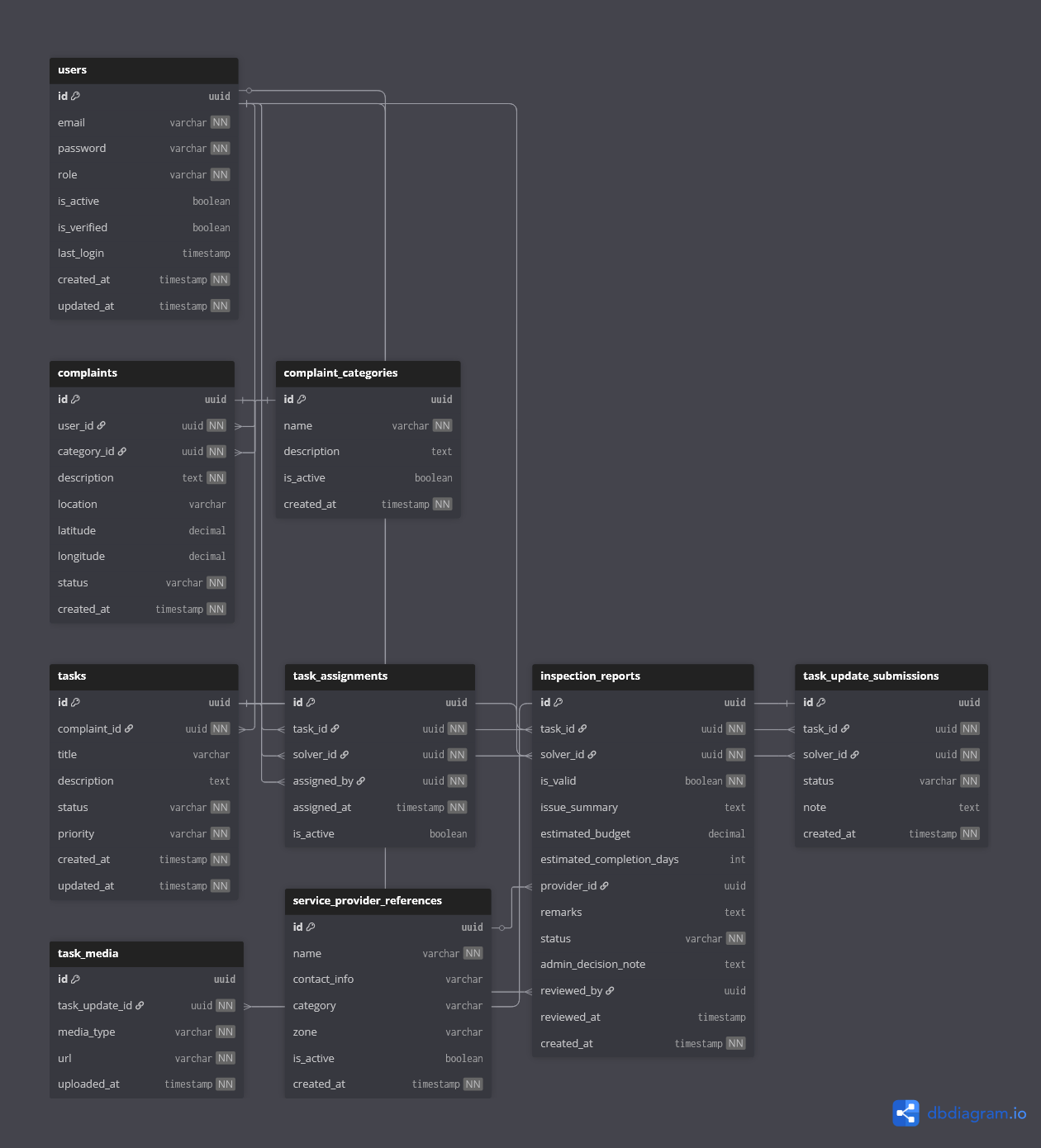
This diagram illustrates how complaints transition into tasks and how solvers and administrators collaborate during resolution.
🧠 Design Notes
- Tasks are created only after administrative review of complaints.
- Assignment history is preserved for audit and reassignment scenarios.
- Inspection reports allow field-level verification before approval.
- Budget estimation is advisory and subject to admin approval.
- Task updates provide continuous progress tracking.
- Media evidence ensures transparency and accountability.